
If you’ve been researching types of laser eye surgery to correct your vision, you’re already on the right track. With so many advanced treatments available today—from LASIK to SMILE to Contoura Vision—it can feel overwhelming to decide which option is ideal for you. Whether you want freedom from glasses, someone you know is exploring refractive surgery, or they have been recommended a specialized technique, understanding each method clearly helps you make a confident decision.
This comprehensive 2025 guide explains 10 different types of laser eye surgery, how they work, who they’re suitable for, and the advantages and disadvantages of each. By the end, you’ll know exactly which procedure aligns best with your eye condition, lifestyle, and long-term vision goals.
Understanding Laser Eye Surgery: A Quick Overview
Laser eye surgery refers to advanced medical procedures that reshape the cornea to correct refractive errors like nearsightedness (myopia), farsightedness (hyperopia), and astigmatism. The cornea’s shape determines how light bends into your eye, so modifying it improves clarity without needing glasses.
The biggest advantage?
Modern technologies allow ultra-precise corrections, faster recovery, and minimal discomfort.
Before choosing from various types of laser eye surgery, your surgeon will examine:
- Corneal thickness
- Eye pressure
- Pupil size
- Existing refractive error
- Dry eye condition
- Age and lifestyle
- Overall eye health
With this information, the surgeon recommends the option that delivers the safest and best visual outcome for you.
1. LASIK (Laser-Assisted In Situ Keratomileusis)
LASIK is the world’s most popular refractive eye surgery. When people talk about laser vision correction, LASIK is usually the first option that comes to mind.
How LASIK Works
A femtosecond laser creates a thin corneal flap. Then, an excimer laser reshapes the underlying cornea to correct refractive errors. The flap is repositioned and heals naturally.
Ideal For
- Mild to severe myopia
- Mild to moderate hyperopia
- Astigmatism
- People with adequate corneal thickness
Advantages
- Quick procedure (10–15 minutes per eye)
- Minimal discomfort
- Vision improves within 24 hours
- Highly accurate and safe
Disadvantages
- Not suitable for very thin corneas
- Rare flap-related complications
LASIK remains the go-to choice for millions because of its proven track record and fast recovery.
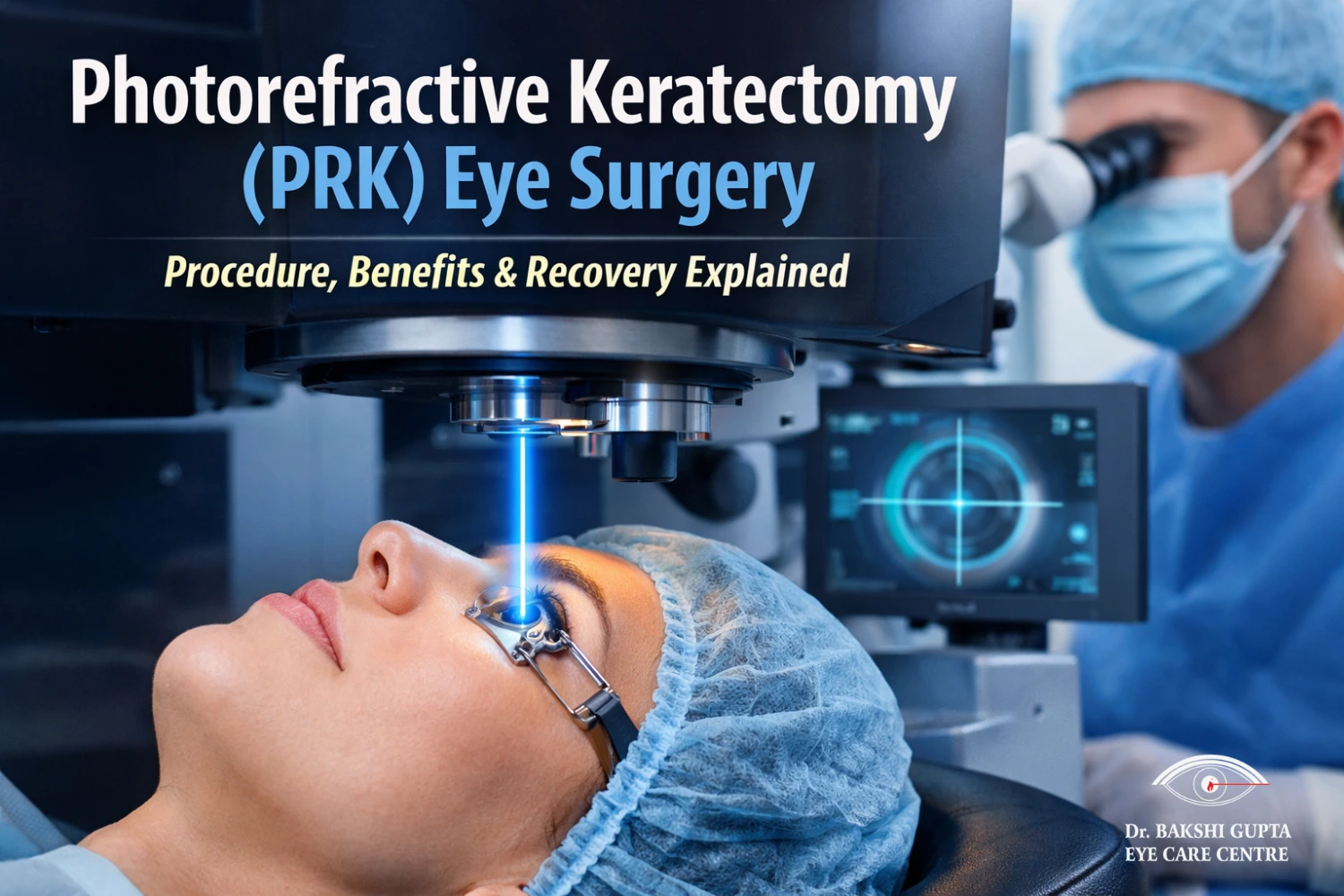
2. PRK (Photorefractive Keratectomy)
PRK is one of the earliest types of laser eye surgery, still widely used for patients who don’t qualify for LASIK due to thin or irregular corneas.
How PRK Works
Instead of creating a flap, the surgeon removes the outer layer of the cornea (epithelium), reshapes the cornea using an excimer laser, and places a bandage lens for healing.
Ideal For
- Thin corneas
- Mild to moderate refractive errors
- People with active lifestyles (athletes, army, etc.)
Advantages
- No flap needed
- Good for people prone to eye injuries
- Long-term results similar to LASIK
Disadvantages
- Recovery takes longer (up to 1–2 weeks)
- Temporary discomfort and blurry vision initially
If you want excellent results but aren’t eligible for LASIK, PRK is a strong option.
3. SMILE (Small Incision Lenticule Extraction)
SMILE is one of the most advanced and minimally invasive refractive surgeries available today.
How SMILE Works
A femtosecond laser creates a small, disc-shaped tissue inside the cornea (lenticule). The surgeon removes this through a tiny incision, reshaping the cornea internally.
Ideal For
- Mild to severe myopia
- Astigmatism
- People with dry eyes
Advantages
- No flap — reduces dry eye risk
- Very small incision (2–4 mm)
- Quick recovery and minimal discomfort
Disadvantages
- Not suitable for hyperopia
- Limited treatable range compared to LASIK
SMILE is often recommended for individuals who want a safer alternative with less post-surgery dryness.
4. Contoura Vision LASIK (Topography-Guided LASIK)
Contoura Vision is an advanced version of LASIK that uses eye-mapping technology to customize treatment precisely to your corneal topography.
How It Works
An ultra-detailed 3D map scans up to 22,000 points on your cornea. The laser corrects irregularities based on these measurements.
Ideal For
- People with irregular corneas
- Astigmatism
- Glasses users seeking sharp, HD-quality vision
Advantages
- Ultra-sharp visual outcomes
- Reduces glare and halos
- Customised to your eye structure
Disadvantages
- Slightly higher cost than standard LASIK
- Not suitable for severe irregularities or very thin corneas
Many patients report better-than-20/20 vision with Contoura Vision.
5. Epi-LASIK (Epithelial Laser In Situ Keratomileusis)
A variation of PRK, Epi-LASIK removes the epithelial layer using an epithelial separator instead of alcohol or a blade.
How It Works
The epithelial layer is separated and lifted, the cornea is reshaped, and the epithelium regenerates naturally.
Ideal For
- Thin corneas
- Dry eyes
- Contact sports players
Advantages
- No flap
- Less discomfort than PRK
- Suitable for military and athletes
Disadvantages
- Longer recovery than LASIK
- Temporary haze in some cases
Epi-LASIK is a safer option for individuals with delicate corneal structures.
6. LASEK (Laser Epithelial Keratomileusis)
LASEK combines features of both PRK and LASIK.
How LASEK Works
A diluted alcohol solution loosens the epithelial layer, which is lifted as a thin flap. After laser reshaping, the flap is repositioned.
Ideal For
- Thin or flat corneas
- High-risk occupations
- Individuals not suitable for LASIK
Advantages
- Suitable for complex cases
- Reduced risk of dry eye
- No corneal flap complications
Disadvantages
- Slightly longer healing
- More discomfort than LASIK
It remains a preferred option for patients requiring a no-flap surgery with a more conservative approach.
7. Wavefront-Guided LASIK
Wavefront technology customizes your LASIK procedure based on how light travels through your eye.
How It Works
A special device measures optical imperfections called higher-order aberrations (HOAs). The laser adjusts the cornea to reduce these irregularities.
Ideal For
- Night-time glare issues
- Mild to moderate refractive errors
- People seeking premium visual clarity
Advantages
- Sharper night vision
- Reduced halos or starbursts
- More personalized than traditional LASIK
Disadvantages
- Higher cost
- Requires stable refractive power
This is excellent for people who need superior night-driving clarity or work in low-light conditions.
8. Wavefront-Optimized LASIK
Instead of measuring HOAs, this method preserves the natural shape of the cornea to avoid distortions.
How It Works
The laser works to maintain the prolate shape of the cornea, reducing spherical aberrations.
Ideal For
- Mild to severe myopia
- People wanting enhanced sharpness
- Patients unsuitable for wavefront-guided LASIK
Advantages
- Lower risk of glare
- Good for a wide range of prescriptions
- Quicker healing
Disadvantages
- Less personalized than wavefront-guided
- May not correct complex aberrations
Wavefront-optimized LASIK remains one of the safest and most commonly used approaches worldwide.
9. ReLEx SMILE PRO (latest SMILE upgrade)
This is the newest innovation in small-incision laser surgery, offering faster healing and greater precision.
How It Works
A next-gen femtosecond laser removes the lenticule even more gently and accurately than standard SMILE.
Ideal For
- High myopia
- Active individuals
- People wanting minimal downtime
Advantages
- Shorter procedure time
- Enhanced visual outcomes
- Even smaller incision than SMILE
Disadvantages
- Limited availability
- Higher cost
If you want cutting-edge laser eye surgery, SMILE PRO is among the best 2025 options.
10. PRESBYOND Laser Blended Vision (for 40+ age group)
Unlike traditional types of laser eye surgery that correct distance vision, PRESBYOND focuses on both distance and near vision.
How It Works
The laser blends your depth of focus, creating a customized solution for presbyopia.
Ideal For
- People aged 40+
- Presbyopia patients
- Those tired of reading glasses
Advantages
- Clear near and far vision
- Less dependence on spectacles
- Natural visual experience
Disadvantages
- Requires brain adaptation
- Not suitable for every eye type
This is one of the best modern alternatives to monovision LASIK for age-related vision loss.
How to Choose the Right Type of Laser Eye Surgery
Choosing the ideal procedure depends on your individual eye health, lifestyle, and long-term vision goals. Here’s how you can narrow it down:
1. Corneal Thickness
- Thick cornea → LASIK, Contoura, Wavefront
- Thin cornea → PRK, LASEK, Epi-LASIK
2. Lifestyle
- Athletes or military → SMILE, PRK
- Desk job or low-risk lifestyle → LASIK, Contoura
3. Dry Eyes
- Severe dry eye → SMILE
- Mild dryness → Wavefront LASIK
4. Age
- Below 40 → LASIK, SMILE
- Above 40 → PRESBYOND
5. Refractive Error
- High myopia → SMILE PRO, LASIK
- Astigmatism → Contoura, Wavefront
6. Eye Shape or Corneal Irregularities
- Irregular cornea → Contoura Vision
- Higher-order aberrations → Wavefront-guided LASIK
A detailed consultation with a refractive surgeon is essential for determining the safest option.
| Decision Factor | Condition / Situation | Recommended Laser Eye Surgery Types |
| 1. Corneal Thickness | Thick cornea | LASIK, Contoura, Wavefront |
| Thin cornea | PRK, LASEK, Epi-LASIK | |
| 2. Lifestyle | Athletes, military, high-impact activities | SMILE, PRK |
| Desk job, low-risk lifestyle | LASIK, Contoura | |
| 3. Dry Eyes | Severe dry eye | SMILE |
| Mild dryness | Wavefront LASIK | |
| 4. Age | Under 40 years | LASIK, SMILE |
| Above 40 years | PRESBYOND | |
| 5. Refractive Error | High myopia | SMILE PRO, LASIK |
| Astigmatism | Contoura Vision, Wavefront | |
| 6. Eye Shape / Corneal Irregularity | Irregular cornea | Contoura Vision |
| Higher-order aberrations (HOAs) | Wavefront-guided LASIK |
Recovery After Laser Eye Surgery
Each surgery type offers different recovery experiences:
1. Fastest Recovery Methods
- LASIK
- SMILE
- Contoura
- SMILE PRO
2. Slower Recovery Methods
- PRK
- Epi-LASIK
- LASEK
3. General Recovery Tips
- Avoid rubbing your eyes
- Limit screen time for the first 24–48 hours
- Use prescribed eye drops
- Wear sunglasses outdoors
- Sleep well to help healing
Most patients achieve stable vision within a few days to a few weeks, depending on the procedure.
Risks and Possible Side Effects
While modern surgeries are extremely safe, some temporary side effects may occur:
- Dry eyes
- Glare or halos
- Mild discomfort
- Light sensitivity
- Temporary visual fluctuations
These symptoms typically resolve as the eyes heal.
Why Choosing the Right Centre Matters
Laser surgery is a long-term decision. Factors to consider while selecting an eye care centre:
- Surgeon experience
- Technology available
- Success rates
- Transparency in pricing
- Post-operative care
For example, if you are searching for the best eye hospital panchkula, ensure they offer modern technology and trained surgeons like those at dr bakshi gupta eye care centre who specialize in advanced refractive procedures.
FAQs About Types of Laser Eye Surgery
1. Which type of laser eye surgery is the safest?
All modern procedures are safe when performed by experts, but SMILE is considered one of the safest due to no corneal flap.
2. What is the best option if I have thin corneas?
PRK, LASEK, or Epi-LASIK are suitable choices.
3. How long does laser eye surgery last?
Most people enjoy permanent results, though natural age-related changes may occur after 40.
4. Can I get laser eye surgery if I have dry eyes?
Yes—SMILE is ideal for dry eyes because it preserves nerves responsible for tear production.
5. Is Contoura Vision better than LASIK?
Contoura Vision offers more customization and can improve visual quality beyond 20/20 for some people.
6. Does laser eye surgery hurt?
Most procedures are painless. You may feel slight pressure but no sharp pain.
7. How soon can I return to work?
With LASIK and SMILE, most people resume work the next day. PRK may require 3–7 days.
8. Is there an age limit for laser vision correction?
Most people qualify between ages 18–50. People above 40 may prefer PRESBYOND.
9. What if my power comes back after surgery?
Enhancements or touch-ups may be possible depending on corneal thickness.
10. How do I know which surgery is right for me?
A detailed eye examination is the only way to determine the safest and most effective option.
Final Thoughts
Understanding the types of laser eye surgery is the first step toward making an informed decision. Each method—whether LASIK, PRK, SMILE, Contoura Vision, or PRESBYOND—offers unique benefits. What works for one person may not work for another, so selecting the right procedure depends on your eye health, lifestyle, refractive error, and personal expectations.
If you take time to understand these techniques and consult an experienced surgeon, you can confidently choose the procedure that offers the best clarity, safety, and long-term stability.