If you’re tired of glasses or contact lenses, smile eye surgery may be the advanced laser vision correction option you’re looking for. Over the last decade, smile corrective eye surgery has gained global popularity as a minimally invasive alternative to LASIK eye surgery. It offers faster healing, less dryness, and long-term visual stability for suitable candidates.
What is SMILE Corrective Eye Surgery?
SMILE (Small Incision Lenticule Extraction) is an advanced, flap-less laser vision correction procedure designed to reduce dependence on glasses and contact lenses. It is primarily used to treat:
- Myopia (nearsightedness)
- Myopia with astigmatism
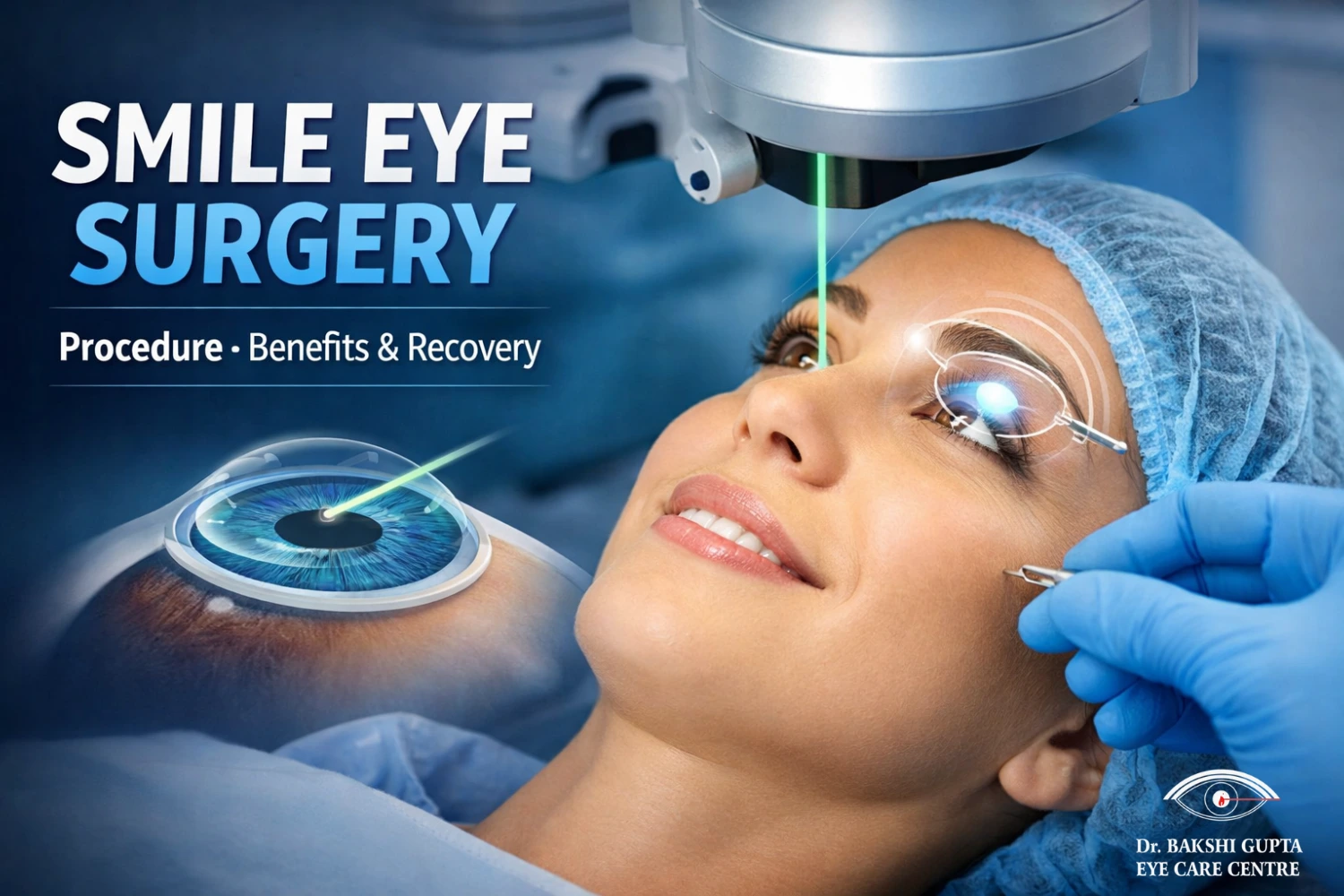
Unlike traditional LASIK, SMILE eye surgery does not involve creating a large corneal flap. Instead, a highly precise femtosecond laser creates a small, lens-shaped piece of tissue (called a lenticule) inside the cornea. This lenticule is then removed through a tiny incision measuring just 2–4 mm, reshaping the cornea and correcting vision.
Because no flap is created, the corneal structure remains more stable, and the risk of flap-related complications is eliminated.
Key Technical Facts About SMILE:
| Feature | SMILE Eye Surgery |
| Laser Type | Femtosecond laser |
| Incision Size | 2–4 mm |
| Procedure Time | 10–15 minutes (both eyes) |
| Recovery | 24–48 hours functional recovery |
| Approval | FDA approved since 2016 |
More than 5 million SMILE procedures have been performed globally, with clinical studies showing patient satisfaction rates above 95%.
How Does SMILE Eye Surgery Work?
Step-by-Step SMILE Procedure Explained
Understanding how smile eye surgery is performed can significantly reduce anxiety and help you make a confident, informed decision. The procedure is minimally invasive, flap-free, and typically completed within minutes. Here’s a clear breakdown of what happens during smile corrective eye surgery:
Step 1: Pre-operative Evaluation
Before proceeding, your surgeon conducts a detailed eye examination to confirm your smile eye surgery eligibility. This ensures safety, accuracy, and predictable results.
Your evaluation includes:
- Corneal thickness measurement – Ensures sufficient corneal tissue for reshaping
- Corneal topography mapping – Creates a detailed surface map of the cornea
- Pupil size assessment – Helps prevent night vision issues
- Tear film analysis – Evaluates dry eye risk
- Refraction stability check – Confirms stable prescription for at least 12 months
This step is crucial for determining whether smile eye surgery is the right option for you.
Step 2: Numbing the Eye
On the day of the procedure, anesthetic eye drops are applied to ensure complete comfort.
- No injections
- No general anesthesia
- You remain awake but feel no pain
Most patients report only mild pressure sensations during smile corrective eye surgery.
Step 3: Laser Lenticule Creation
A highly precise femtosecond laser creates a thin, disc-shaped piece of tissue (called a lenticule) inside the cornea.
- The laser works in seconds
- No corneal flap is created
- Accuracy is controlled by computer-guided mapping
This step reshapes the internal corneal structure to correct vision.
Step 4: Small Incision
Your surgeon makes a tiny 2–4 mm micro-incision on the corneal surface.
- Much smaller than LASIK incisions
- Preserves corneal strength
- Reduces dry eye risk
Because smile eye surgery is flapless, structural stability is better maintained.
Step 5: Lenticule Removal
The surgeon gently removes the lenticule through the small opening.
- Corneal shape changes immediately
- Vision correction begins instantly
- No stitches required
Once removed, the cornea naturally seals itself.
Total Procedure Time
- 10–15 minutes for both eyes
- Each eye typically takes 5–7 minutes
- You go home the same day
There are no stitches, no flap creation, and minimal discomfort. Most patients experience clearer vision within 24–48 hours after smile eye surgery.
Smile Eye Surgery Eligibility: Are You a Good Candidate?
Not everyone qualifies for smile corrective eye surgery. Proper evaluation ensures safe outcomes.
Basic Eligibility Criteria
You may be eligible if:
- Age: 18–40 years
- Stable prescription for at least 1 year
- Myopia up to -10.00 D
- Astigmatism up to -5.00 D
- Healthy cornea thickness
- No active eye infections
Who Should Avoid SMILE?
- Severe dry eye syndrome
- Keratoconus
- Autoimmune disorders
- Pregnancy or breastfeeding
- Unstable vision prescription
A comprehensive evaluation determines your smile eye surgery eligibility accurately.
Benefits of SMILE Eye Surgery
SMILE eye surgery is widely preferred for its minimally invasive design and faster recovery compared to traditional laser procedures. Because it does not require creating a large corneal flap, it preserves more of the eye’s natural structure while delivering highly accurate vision correction. Below are the key benefits explained in a clear and practical way:
1. Minimally Invasive
SMILE eye surgery uses a tiny 2–4 mm incision instead of a large flap. This means:
- Less disruption to corneal nerves
- Reduced risk of flap-related complications
- Better preservation of corneal integrity
2. Reduced Dry Eye Risk
One of the biggest advantages of SMILE corrective eye surgery is lower incidence of post-operative dryness. Clinical studies indicate:
- Up to 30–40% less dry eye symptoms compared to LASIK
- Faster tear film recovery
- Improved comfort during healing
3. Faster Healing
Most patients experience rapid functional recovery. Typically:
- Clearer vision within 24–48 hours
- Return to work in 1–2 days
- Minimal downtime for daily activities
4. Stronger Corneal Stability
Since no large flap is created:
- Corneal biomechanics remain more stable
- Reduced long-term structural weakening
- Better safety margin for active individuals
5. Minimal Pain
SMILE eye surgery is generally comfortable. Patients report:
- Mild irritation or watery eyes for a few hours
- No stitches required
- Quick relief with prescribed drops
6. Long-Term Results
Long-term clinical data supports stable outcomes:
- Over 95% patient satisfaction rate
- Stable vision correction for 5+ years
- Low regression rates in eligible candidates
Overall, SMILE eye surgery combines precision, safety, and comfort, making it an increasingly popular choice for people seeking long-term vision correction with minimal disruption.
SMILE vs LASIK:
| Feature | SMILE Eye Surgery | LASIK |
| Flap Creation | No | Yes |
| Dry Eye Risk | Lower | Higher |
| Recovery Speed | Fast | Very Fast |
| Suitable for | Myopia & Astigmatism | Myopia, Astigmatism, Hyperopia |
| Corneal Strength | Better preserved | Slightly reduced |
For patients concerned about dry eyes or flap complications, smile corrective eye surgery may be preferable.
Recovery Timeline After SMILE Eye Surgery
1. First 24 Hours
- Mild irritation
- Slight blurry vision
- Light sensitivity
48 Hours
- Clearer vision
- Resume light activities
- Avoid screen strain
1 Week
- Vision stabilizes
- Resume work fully
1 Month
- Follow-up evaluation
- Optimal visual clarity
Post-Operative Care Tips:
- Avoid rubbing eyes
- Use prescribed antibiotic & lubricating drops
- Avoid swimming for 2 weeks
- Wear UV protective sunglasses
Risks and Complications of SMILE Eye Surgery
While smile eye surgery is considered safe, no procedure is risk-free.
Possible side effects:
- Temporary dryness
- Mild glare or halos at night
- Under-correction (rare)
- Infection (extremely rare <1%)
Success rate is above 96–98% for achieving 20/25 vision or better.
Long-Term Outcomes of SMILE Corrective Eye Surgery
Clinical research (5-year follow-up studies) indicates:
- 95% patients maintain stable vision
- Less regression compared to PRK
- Lower incidence of chronic dry eye
Vision stabilization usually occurs within 3 months.
Common Myths About SMILE Eye Surgery
Myth 1: It’s Painful
Reality: Only mild discomfort for a few hours.
Myth 2: Vision Changes Permanently in a Bad Way
Reality: Permanent reshaping, but aging changes like presbyopia still occur.
Myth 3: Recovery Takes Weeks
Reality: Functional recovery within 48 hours.
Preparing for SMILE Eye Surgery
Before your procedure:
- Stop contact lenses 1 week prior
- Avoid eye makeup 48 hours before
- Arrange transportation
- Eat light meal before surgery
Frequently Asked Questions (FAQs)
1. Is SMILE eye surgery permanent?
Yes, smile eye surgery permanently reshapes the cornea. However, age-related changes like reading glasses after 40 may still occur.
2. Is SMILE safer than LASIK?
Both are safe, but smile corrective eye surgery may reduce dry eye risk and flap-related complications.
3. How long does the procedure take?
Around 10–15 minutes for both eyes.
4. When can I drive after SMILE?
Usually within 24–48 hours after doctor approval.
5. What is the success rate of SMILE eye surgery?
Clinical success rate exceeds 96%.
6. Does insurance cover SMILE?
Generally considered elective, so most insurance plans do not cover it.
Expert Summary: Is SMILE Eye Surgery Worth It?
If you’re eligible, smile eye surgery offers:
- Minimally invasive correction
- Faster recovery
- Reduced dry eye risk
- Long-term stable vision
With millions of successful procedures worldwide and high satisfaction rates, smile corrective eye surgery is one of the most advanced laser vision correction options available today.
Always consult an experienced ophthalmic surgeon to confirm your smile eye surgery eligibility before proceeding.